

Authored By Amanda Kirsch | Senior Manager
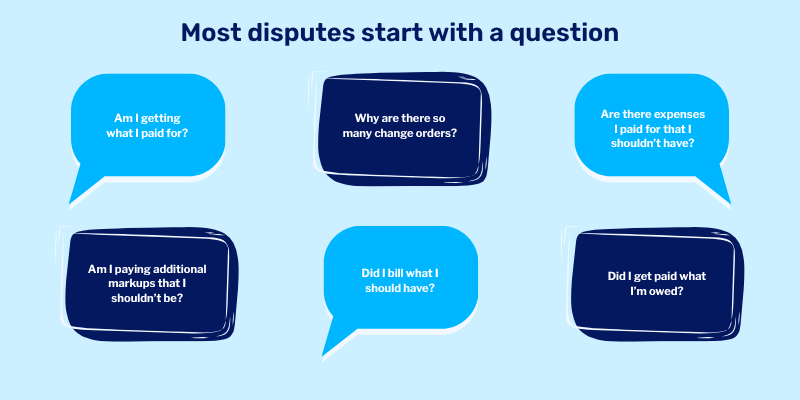
Billing Disputes during construction projects rarely begin as major conflicts. More often, they stem from unanswered questions or misaligned expectations.
Construction projects move quickly and often involve multiple change orders. As a result, real-time decisions can outpace the words in a contract.
As unanswered questions compound, assumptions replace facts. Positions harden and trust erodes.
A construction audit helps address this dynamic by establishing an objective, fact-based evaluation of what occurred versus the contract requirements. These established facts create a foundation for stakeholders to evaluate issues and pursue resolution before they escalate into formal claims or litigation.
When Small Issues Escalate to Larger Problems
Billing disputes are rarely resolved on their own. Instead, they build over time. Most disputes during construction projects trace back to three root causes:
Contract Interpretation Gaps
Construction agreements can be complex. As project scopes evolve, it becomes increasingly difficult to capture everything in a single agreement. Projects with cost-plus arrangements are especially vulnerable when there is ambiguity around allowable costs, prescribed markups, or labor burdens.
An experienced auditor does not interpret the contract or take a legal position. However, they can provide an objective view of the facts and quantify the financial impact of differing interpretations. This often helps stakeholders better understand their respective positions and areas of exposure.
Scope Drift
As projects progress, scope evolves in both expected and unexpected ways. Tracking these changes and maintaining cost accountability can be difficult. Informal approvals can intermingle with signed change orders, creating gaps between expectations and documented agreements.
Even well-managed projects experience scope drift, which can lead to unexpected costs and delayed payments. An audit brings structure to this complexity by organizing the facts, quantifying impacts, and distinguishing actual changes from perceived ones.
Information Gaps
Information gaps occur when one party has access to billing details or cost data that the other does not. In the absence of transparency, assumptions often replace facts, increasing friction between stakeholders.
By establishing transparency and validating key data, audits give stakeholders greater confidence in the accuracy of payment applications and supporting documentation. This supports more informed decision-making and more efficient processes.
How Construction Audits Help Address Billing Disputes
What Construction Audits Actually Do
Construction audits establish objective facts. They compare project activity to contract requirements by analyzing billing records, cost detail, payroll records, time reporting, and supporting documentation.
Common audit procedures include:
- Reconciling billed labor to payroll and time records
- Validating labor burden rates against contract terms and statutory requirements
- Assessing the accuracy and reasonableness of pass-through costs
- Verifying compliance with contractual markups
- Reviewing usage of allowances and contingencies
- Confirming the accuracy of the general conditions
Through this process, audits identify non-compliant charges and organize findings into a clear, fact-based assessment of where billings do and do not align with the contract.
Audits do not resolve disputes or determine legal outcomes. They establish the financial facts and quantify exposure so stakeholders can evaluate issues and determine next steps.
Why Construction Audits Help Change the Conversation
When facts are established and clearly presented, the conversation shifts.
Construction audits:
- Replace assumptions with facts
- Help stakeholders understand risk and financial exposure
- Create opportunities to course-correct, even while a project is ongoing
- Provide a shared, fact-based starting point for addressing billing concerns
From Observations to Informed Decision Making
Establishing the facts is essential. Resolution occurs when stakeholders use those facts to evaluate issues, take corrective action, and address financial impact.
An audit organizes information around contract terms, allowing stakeholders to focus on the most relevant issues and move forward with a common understanding.
If a commercial resolution cannot be reached, audit findings can support litigation strategy by quantifying exposure and organizing complex documentation into a clear, defensible narrative.
In some cases, engaging an auditor before a formal dispute arises can help stakeholders assess exposure early and determine whether escalation is necessary. With better information, some parties are able to avoid formal legal action altogether.
How to Avoid Contract Billing Disputes in the Future
Taking a proactive approach to contract compliance can reduce the likelihood of disputes forming in the first place.
Pre-Construction Agreement Review
Every word in an agreement carries weight. A detailed review can help identify undefined terms or potential areas of ambiguity before work begins.
Clear, well-defined contract language reduces the likelihood of misalignment later in the project.
Mid-Construction Audits
Rather than waiting for disputes to surface, audits can be performed during the project to confirm alignment with contract terms.
This allows stakeholders to address questions in real time, reduce uncertainty, and avoid compounding issues.
Moving Forward With Clarity
Disputes often escalate in the absence of clear, reliable information. When facts are established, exposure is understood, and key issues are defined, stakeholders are better positioned to address challenges effectively.
A construction audit provides the financial clarity needed to support that process.
If questions are beginning to surface, now is the time to address them. Connect with SC&H.