

With the rise of digital transformation, demand for hyperscale data center construction is accelerating at an unprecedented pace. AI alone is projected to account for nearly 28% of overall data center demand by 2027. At the same time, the data center construction market size is expected to grow from $261.31 billion in 2025 to $662.71 billion by 2033, intensifying both the scale and speed of development.
When timelines tighten at this scale, risk does not simply increase. It compounds across cost, schedule, and operational performance.
Understanding where those risks emerge, and how to manage them without slowing momentum, is the difference between a project that delivers and one that compounds risk.
Why Hyperscale Data Center Construction is Fundamentally Different
Data center construction does not follow the same playbook as a typical commercial build.
Key differences include:
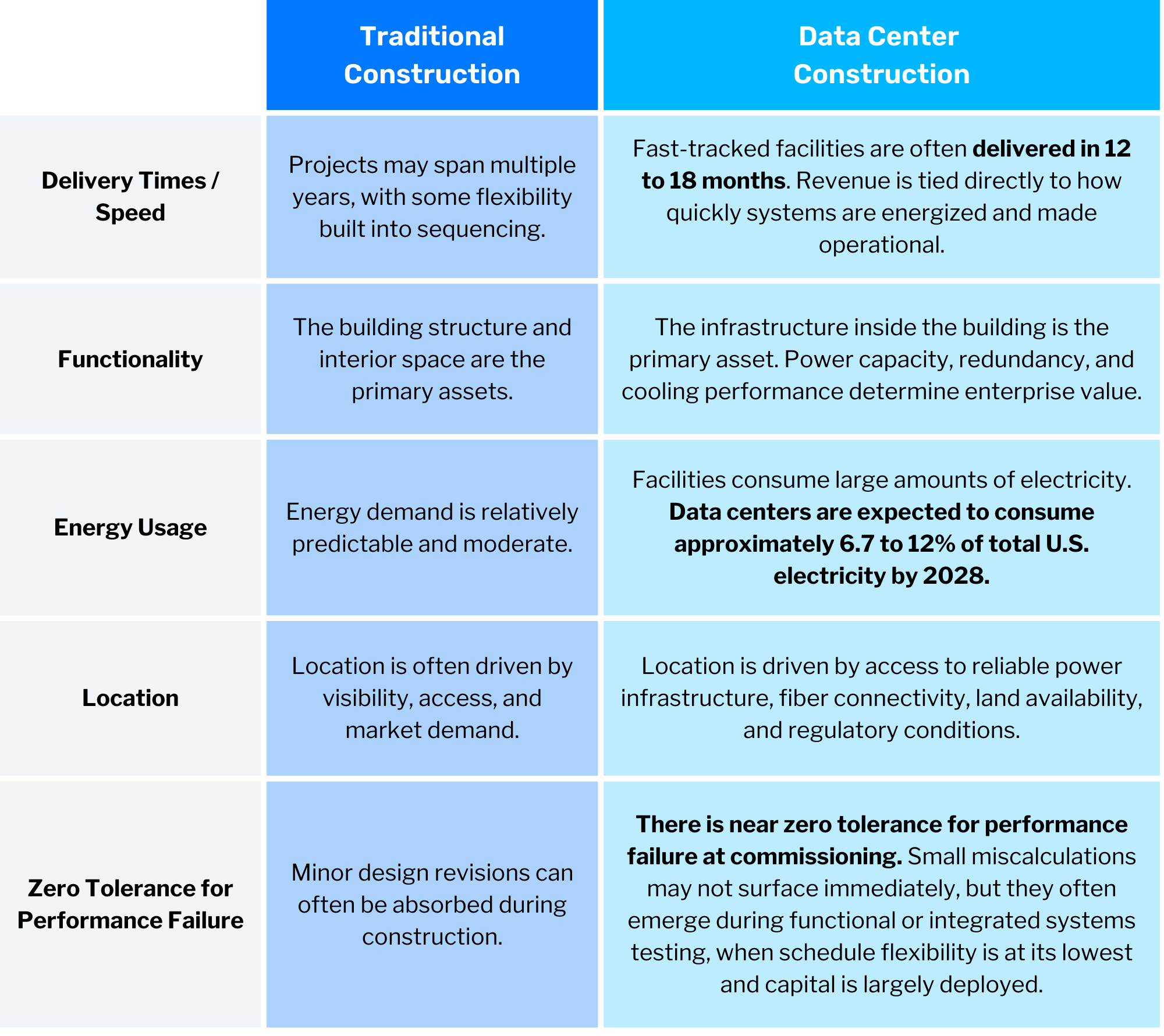
The same factors that make data center construction unique also make it far less forgiving when timelines compress.
The Risks of Building Data Centers at Hyperscale Speed
The push to build at hyperscale speed does not come without consequence. As timelines tighten and infrastructure complexity increases, risk becomes harder to contain.
Schedule Compression
To maintain momentum when working on a fast-tracked project, teams may move forward before every detail is fully resolved. In some cases, “good enough” becomes the working standard.
That approach can protect schedule in the short term, but it introduces compounding downstream risk:
- Design gaps surface late. As scope evolves and specifics become clearer, earlier decisions may prove incomplete or incorrect.
- Out-of-sequence installation. When electrical, mechanical, and controls systems are installed or energized before upstream infrastructure and redundancy paths are fully complete, commissioning becomes reactive instead of structured. Failed functional and integrated systems tests often trigger rework, resequencing, and delayed energization when revenue milestones are approaching.
- Change orders multiply. Construction may continue before changes are fully documented or approved, resulting in after-the-fact change orders and reduced cost visibility.
Owners are eager to begin generating revenue, customers are preparing to deploy capacity, and investors expect predictable, timely returns. That urgency can make it tempting to prioritize progress over precision.
But in data center construction, “good enough” is rarely good enough. When systems are tightly integrated and performance-driven, even small design gaps can create operational risk, commissioning delays, or in extreme cases, outages.
Supply Chain and Procurement Constraints
Fast-tracked hyperscale projects are heavily dependent on specialized equipment and coordinated procurement.
Critical components such as transformers, switchgear, generators, and cooling systems are often custom-built and come with long lead times. When delivery timelines slip, the effects are immediate and can include:
- Extended lead times. Custom-built infrastructure can delay sequencing and compress already tight schedules.
- Rising equipment costs. Price volatility and accelerated procurement can strain project budgets.
- Idle labor. Crews may remain on site waiting for key components to arrive, resulting in lost productivity.
- Commissioning delays. Even minor equipment setbacks can ripple into go-live timelines and revenue milestones.
- Operational exposure. Poorly sourced or faulty components can compromise uptime and require costly remediation.
- Sustainability and compliance pressure. Growing scrutiny around energy consumption and water usage requires long-term utility coordination and disciplined sourcing decisions.
Cost Escalation
The nature of hyperscale builds accentuates many of the risks found in any construction project. Unexpected costs are the natural result of compressed timelines, evolving scope, and intense market demand. At hyperscale, small percentage shifts translate into material capital impact.
Labor
Hyperscale data center construction depends on specialized trades including high-voltage electricians, controls technicians, and commissioning agents. These resources are often limited in many markets. In regions with overlapping builds, labor demand can outpace supply, driving wage premiums, travel costs, and per diem exposure.
At the same time, compressed schedules often result in stacked trades and early workforce mobilization. When scope is still evolving or long-lead equipment is delayed, crews may remain on site without productive work, eroding margin and distorting labor forecasts.
Change Orders
Design packages are often advanced before full maturity, owner-direct procurement shifts installation scope, and commissioning may uncover performance adjustments late in the schedule.
As a result, change orders can accumulate quickly. While each change may be justified individually, the aggregate effect can distort cost forecasts, accelerate contingency burn, and reduce visibility into remaining GMP exposure. Without disciplined tracking of allowances, escalation clauses, and scope transfers, contingency visibility erodes and financial exposure compounds faster than it appears.
Long-lead Equipment Premium
Critical infrastructure is often custom-built and sourced from a limited number of suppliers which typically carries extended lead times.
To protect aggressive delivery timelines and ensure they receive the products they need, developers may pay high premiums for accelerated fabrication, expedited shipping, or early procurement commitments.
At this scale, even the smallest percentage increases can translate into significant financial impact.
Managing Risk Without Slowing Momentum
The most effective teams do not slow projects down to manage risk. They build guardrails into the process from the start. Here’s what that looks like in practice.
Start with Scope Clarity
Many of the problems that show up later begin with vague scope early on.
- Make sure contracts are clearly written.
- Define responsibilities in plain terms.
- Establish how changes will be documented and approved.
- Confirm long-lead equipment decisions before execution accelerates.
- Align drawings, specifications, and pricing assumptions early.
The clearer the scope, the easier it becomes to evaluate change orders. Since change orders are often one of the biggest drivers of delay and cost growth, clarity upfront is key.
Embed Continuous Cost & Contract Oversight
In fast-moving hyperscale programs, oversight must move at the same speed as execution. Rather than relying on after-the-fact audits, leading organizations embed cost and contract compliance monitoring directly into the project governance lifecycle.
Instead of waiting until closeout or dispute:
- Perform focused, monthly cost and forecast reviews.
- Evaluate labor, equipment and material charges against contract terms in real time.
- Validate subcontractor billings.
- Assess whether change orders reflect true scope evolution or cost drift.
- Monitor contingency burn and escalation exposure against remaining risk.
Specialized labor, custom equipment, compressed schedules, and evolving scope all create opportunities for risk to quietly infiltrate fast-tracked projects. Continuous, embedded oversight allows teams to maintain momentum while ensuring costs, scope, and forecasts remain aligned. Differences can be remediated in real time before the misalignment becomes material.
Embedded governance also builds stakeholder confidence. When both sides operate from the same set of facts, projects move forward with greater certainty and fewer surprises.
In hyperscale construction, speed and control are not opposing forces. The most sophisticated developers treat cost governance as an operational discipline, not a compliance function, integrating the function alongside schedule management, commissioning strategy, and capital planning.
The Bottom Line
Building at hyperscale speed will always carry risk. The question is whether you’re managing that risk in real time or discovering it after capital has already been deployed.
The organizations that navigate these projects most successfully are the ones that stay in control while moving quickly.
For organizations navigating hyperscale development, the right oversight can preserve both velocity and capital. If you’re evaluating how governance and cost transparency are embedded within your current or upcoming builds, let’s talk. Connect with SC&H.