


Authored by Noah Yao | Principal & Lani Chun, PHD | Principal
Data teams in healthcare and life sciences organizations are under more pressure than ever to innovate and deliver. While AI and new technology offer huge opportunities, rising costs and increasing complexity make it harder to turn that potential into real results.
In this article, we’re sharing key lessons from 2025 and practical insights to help organizations set the right priorities for 2026.
Where We Are Now: The Data Explosion
The healthcare and life sciences industries are experiencing an explosion in data volume1, far surpassing traditionally data-rich industries like manufacturing and financial services. This surge of data is a double-edged sword: it drives innovation and better decision-making, but also increases risks around security, operations, and costs.
Balancing this growing data landscape with parallel growth in new technology (e.g., AI/LLMs/NLPs, data quality platforms, data catalogs, etc.) will be key to unlocking tremendous opportunities in the industry.
Emerging Data Trends in Pharma & Healthcare
Data growth & monetization is outpacing governance
Data has become a key organizational asset, driving rising costs and business value by fueling traditional analytics and booming AI demand2. In response to this perceived opportunity, many companies (even those whose primary business is not providing data) are trying to monetize their data.
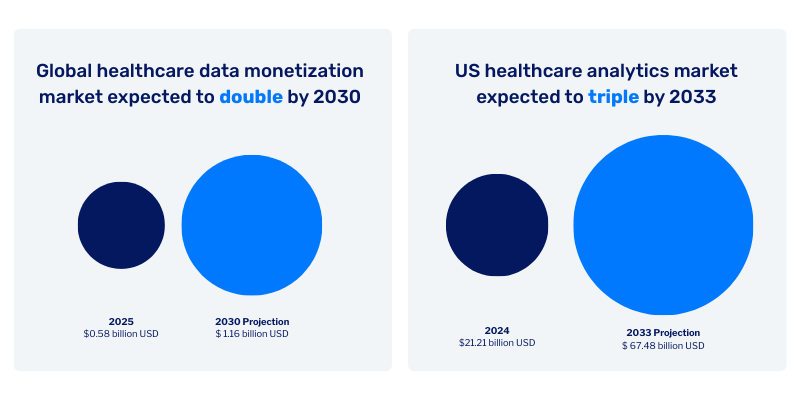
Source: https://www.marketsandmarkets.com/Market-Reports/healthcare-data-monetization-market-56622234.html
Source: https://www.grandviewresearch.com/industry-analysis/us-healthcare-analytics-market-report
Despite this growth, much of the data available is of poor quality and limited usability for analytics and AI. Organizations often procure without a clear strategy or governance discipline, further complicated by persistent data silos across the business3.
Self-serve analytics and the data mesh have been proposed to increase data cohesiveness and agility, but in practice they often lead to data sprawl that lacks any standardization, controls, lineage, or reusability.
Data security is a renewed business priority
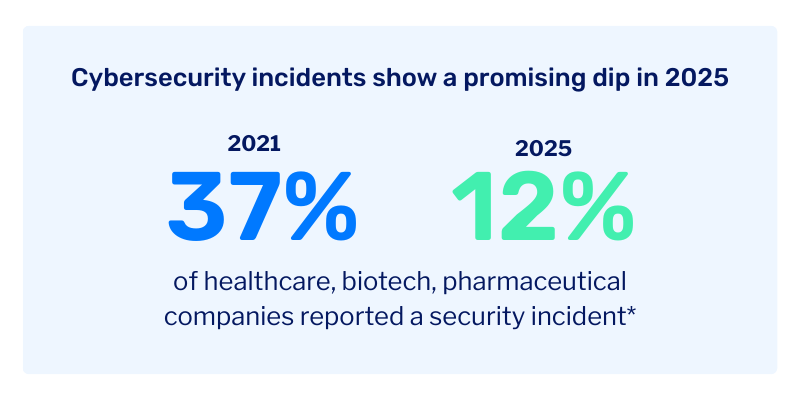
Cybersecurity and data breach incidents show a promising dip in 2025, reversing a prior 8+ year upward trend in prior years4. This reversal reflects increased awareness and stronger efforts to protect patient data and maintain regulatory compliance.
In addition, CDOs are more focused on data security and privacy. Projects such as tokenization, de-identification, and masking have migrated from the CTO’s domain to being funded and governed by the CDO, CSO, or CIO. According to the IBM CDO Study, 52% of CDOs cite data security as their most critical responsibility5.
On top of traditional risks, hacking and ransomware incidents have risen significantly over the past decade6. In response, organizations are building dedicated data security divisions. Job postings for data governance and privacy roles are up as much as 30% year-over-year7. Security and compliance are no longer part-time jobs in an increasingly data-rich, AI-hungry industry.
Technology sprawl in the race to advance data maturity
Technology vendors of all sizes are finding new ways to manage and extract value from data. Keeping track of the tech landscape (new/rebranded offerings, mergers/acquisitions, etc.) is becoming a full-time job.
Unfortunately, this has translated into a tangled web of tech implementations and integrations for many organizations. The average healthcare and life sciences organization now runs as many as 77 SaaS applications and 2 IaaS platforms. One-third manage 500+ APIs, with 14% managing 1,000+8. And the effort needed to implement and maintain new technologies often negates the original intended benefits.
Data is the biggest obstacle to AI innovation
As organizations invest heavily in AI, it’s become clear that most lack the data maturity and vision to support AI initiatives. In fact, Gartner forecasts that organizations will abandon 60% of AI projects in 2026 thanks to poor data quality9.
Nonetheless, healthcare and life science organizations have been aggressively identifying use cases for AI. This includes:
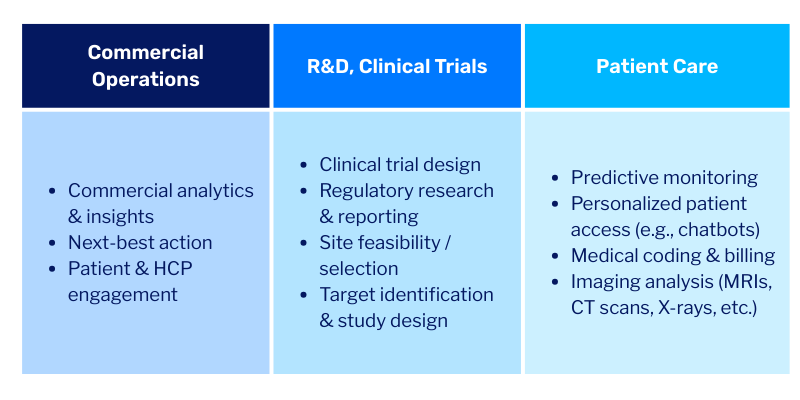
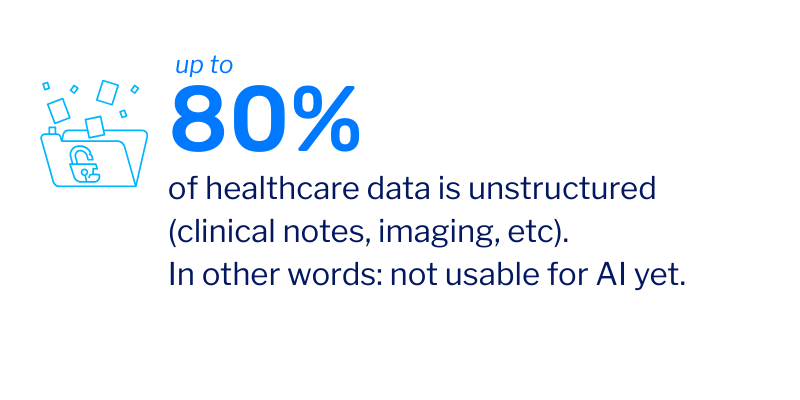
As these pilots have progressed, data has become the primary hindrance, particularly when trying to scale. These initiatives are often put on hold, transitioning into data governance or management initiatives before AI can be pursued further. In a survey of EU pharmaceutical companies, 67% abandoned an AI initiative due to bad data. 96% shared that they did not believe their data was AI-ready10.
“Garbage in, garbage out,” and “Bad data = bad AI.” Platitudes aside, the trend is clear: greater investment in data ecosystem maturity is needed before AI can have a chance for success.
What Matters Most in 2026
The healthcare and life sciences industry will only get more complicated, with increasingly dynamic and disruptive technology. At a high level, we observe the following trends to be primary focus areas:
1. Digital fluency (and patient experience) will be the standard
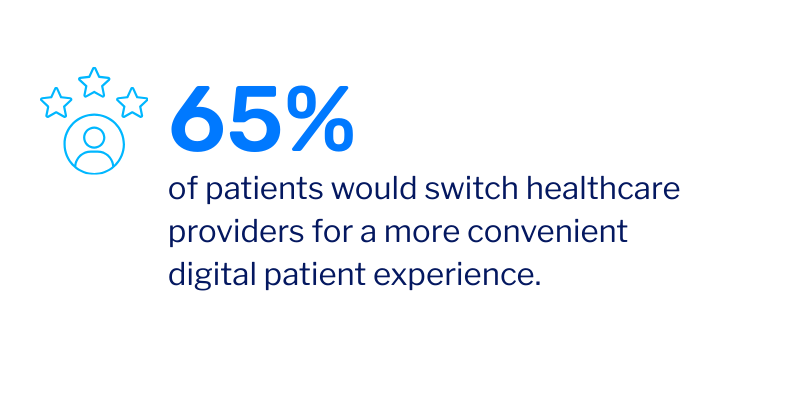
The importance of digital and data literacy is on the rise at all levels of the organization, as well as with patients.
Healthcare and life sciences workforces will be driven to upskill rapidly to take advantage of new analytics and productivity solutions. The digital patient experience will continue to become more connected and personalized, with the intent to drive greater patient engagement and outcomes.
2. AI will shift from pilot to enterprise platform
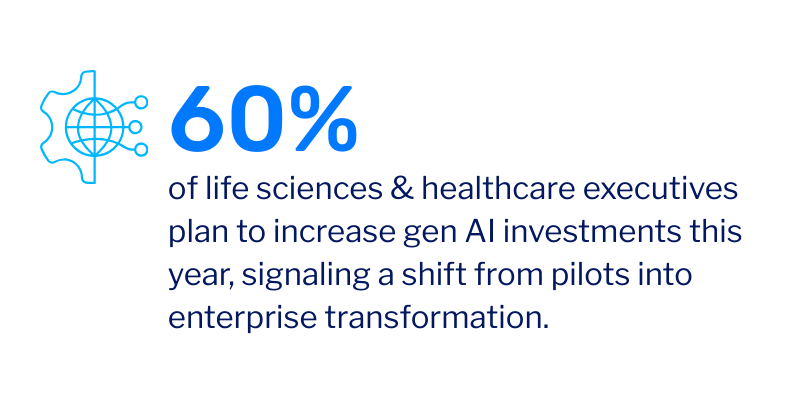
AI is transitioning from experiments and pilots into embedded operations across the enterprise.
Focus on governance and transparency and learn from hard lessons on developing the right data assets and capabilities to support AI use cases. This focus will also prepare your organization for increased regulatory scrutiny from governing bodies around the world around healthcare data and AI.
3. AI will favor companies with integrated data
Consolidation of both data and technology will accelerate to support AI initiatives.
By moving to more integrated, interoperable platforms – with standardized data products, common definitions, and semantic frameworks – organizations can turn siloed data sets into reusable assets that can support AI and a broader range of use cases.
What Data Teams Should Do Next
To enable companies to capitalize on these opportunities, we have identified two guiding principles that will be critical to successful data and technology initiatives in 2026.
1. Determine Your Whys
The word of the year should be “why.” Dress it up as business justification, ROI, or intended outcomes – but it comes down to the same thing. Before purchasing data, implementing new technology, or launching an AI initiative, stop and ask: what business problem are we solving, and who benefits?
Can the investment be traced back to a broader strategy? Do we have the capabilities in place to support it and measure whether it worked? Once you have a clear “why,” you can create a framework to measure success against intent.
2. Determine what works for your organization
As an extension or next step to “why,” we should then be asking “what works for us?”
The market is full of vendors selling a dazzling array of data products to solve every challenge. But not every organization needs the most advanced solution available. Does it fit your functional needs? Do you have the infrastructure to support it? Can you realistically implement it in time to demonstrate impact?
For most organizations, success lies in the middle, where ambition, readiness, and measurable outcomes align. Right-sizing investments and building capabilities you can sustain will matter far more than chasing the latest innovation.
Conclusion
Healthcare and life sciences organizations in 2026 face an existential challenge: how to distill the possibilities and resist the thrill of novelty to invest in what is right for your organization. We’ve seen too many companies buy a big dataset or an “innovative” technology without validating the value, need, or feasibility – this leads to wasted efforts and dollars.
Start by listening to your constituents and stakeholders. Identify the business objectives, pain points, and gaps that will ultimately shape your strategy and requirements. In the age of AI, this is especially important – ensure your data and technology maturity is ready to support an AI initiative, get the right data, and create purpose-built solutions that fulfill high-impact use cases.
As you head into 2026, determine the “why” first, then determine what works for your organization. That’s how data and technology investments translate into measurable business impact.