

Authored by Sarah Reter, CPA | CFO Advisor & Gabby Wrobel , FP&A Manager
At some point, every small or medium-sized business (SMB) has to face the music: the budget spreadsheet that got you here probably cannot take you to the next level.
Nine times out of 10, what once worked to maintain your business isn’t designed to support your growth. Teams expand. Decisions get more expensive. Stakes get higher. And suddenly, you need to understand not just what you’re spending, but why, and how today’s choices impact tomorrow’s results.
So how do you move from “this spreadsheet works fine” to a budget that gives you the necessary visibility to support scaling? For most SMBs, the answer isn’t more data. It’s a better structure.
If you already have a working budget, historical financials, and department-level numbers, it’s time to break up with your chaotic spreadsheet and move to a structured, assumption-driven model. A growth-ready budget gives you a clear performance baseline for now and sets you up for more confident forecasting in the future.
In this guide, we’ll walk through what a growing business’s budget actually needs to include to be useful, scalable, and actionable. After years of working with SMBs on their budgets, we’re also sharing our free SMB Budgeting Template that we built to help you put these ideas into practice without overcomplicating things!
Want to jump straight into the budget template?
Download our free budgeting template now, or keep reading for the full context.
What a Small Business’s Budget Actually Needs to Include
A strong budgeting model doesn’t just hold numbers. It organizes them in a way that supports planning, accountability, and decision-making. Below are the non-negotiables every growing SMB should have in their budget.
Our SMB Budgeting Template includes all of these components, and we designed it so you can easily jump in and budget smarter, not harder.
Start With a Clear Annual Budget (and Don’t Move the Goalposts)
First things first, you need a clear annual budget that acts as your baseline.
This is the plan you set, approve, and use to measure performance. It’s not something you rewrite every time results don’t match expectations. Budgets that are constantly changed make it impossible to assess whether the business is actually performing well or just adjusting the plan to fit reality.
One important caveat: That doesn’t mean your budget gets built once and ignored. As the year progresses, you should layer in actual results and refine timing assumptions so you can see how reality compares to the original plan.
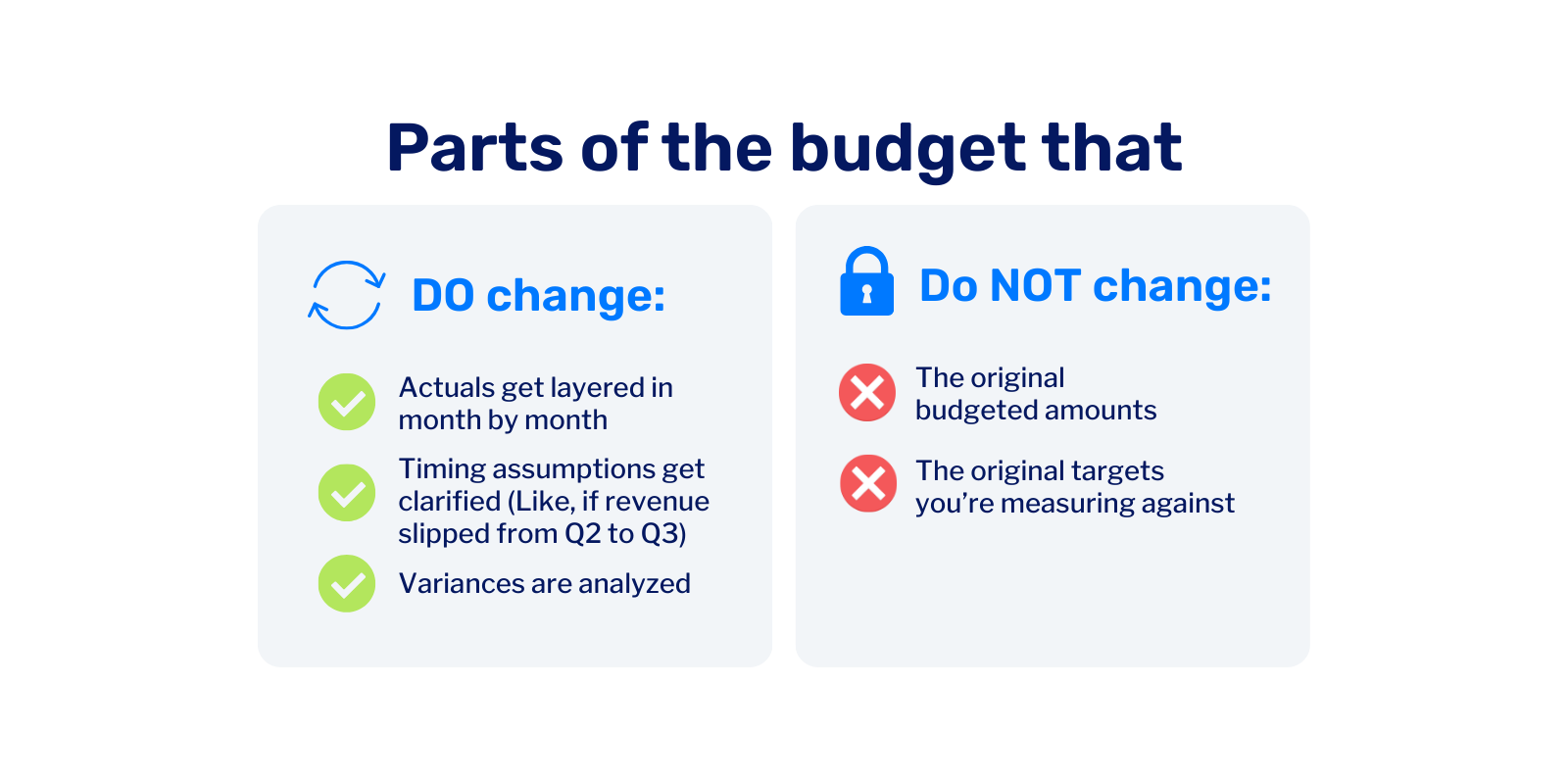
Parts of the budget that DO change:
- Actuals get layered in month by month
- Timing assumptions get clarified (Like, if revenue slipped from Q2 to Q3)
- Variances are analyzed
Parts of the budget that DO NOT change:
- The original budgeted amounts
- The original targets you’re measuring against
The key is not to treat your budget like a forecast, which is a dynamic tool that gets regularly updated.
Budgeting vs. Forecasting
Now, let’s talk about forecasts. This tool DOES evolve throughout the year. A forecast is an updated projection of where your business is likely to end up, based on what’s actually happening. It takes your original plan (the budget), layers in real results, and adjusts for new information, so you can see what the future looks like before you get there.
Here’s how to remember the main difference between budgets and forecasts:
- Your budget answers: What did we plan to do?
- Your forecast answers: Based on what we now know, where are we headed?
Key takeaway? Your budget isn’t meant to change, but your forecast is.
Centralize the Assumptions That Drive Everything
Assumptions are what turn a budget from a static spreadsheet into a tool you can actually use. Without them, every update requires manual edits, extra tabs, and a lot of crossed fingers.
In a growth-ready budgeting model, assumptions need to live in one place and flow through the entire budget automatically. They should be clearly defined, easy to update, and owned by leadership (not buried inside complex formulas).
At a minimum, growing SMBs should clearly define assumptions around:
- Revenue growth expectations
- Salary increases or cost-of-living adjustments (COLA)
- Payroll taxes and benefits burden
- Planned hires and timing
- Year-over-year expense changes (travel, marketing, vendors, etc.)
(Our SMB Budgeting Template makes this super simple, and even includes industry averages to help get you started!)
Build Revenue Plans That Support “What If?” Thinking
Revenue planning shouldn’t be a guessing game.
A growth-ready budget allows you to:
- Establish a clear baseline revenue plan
- Model changes without breaking the budget
- See how revenue shifts affect expenses and profitability
This structure makes it possible to test out decisions before you make them, whether that’s hiring ahead of revenue, expanding into a new market, or taking on a large contract.
Capture the True Cost of Labor (Not Just Salaries)
Labor is usually the largest and most underestimated expense for growing SMBs.
Your budget should clearly reflect:
- Salaried vs. hourly roles
- Payroll taxes, benefits, and bonuses
- Planned hires and timing
- The full cost of headcount growth
When labor assumptions are scattered or incomplete, budget surprises tend to show up later in the year. A clear labor model gives leadership confidence to make growth decisions without unintended consequences.
Use Department-Level Budgets With Clear Ownership
As your organization grows, department-level budgeting becomes essential. But without structure, it can quickly become a headache for everyone.
Effective department budgets require:
- Standardized expense categories
- Clear ownership of inputs
- Guardrails that prevent over-editing or misclassification
When teams know exactly what they own (and where their numbers belong), budgets become more accurate, easier to manage, and far more useful.
Make Rollups and Summaries Automatic
A budget should answer questions, not create more work.
Growing SMBs need a model that:
- Automatically rolls up data across departments
- Clearly summarizes revenue, labor, and expenses
- Supports future budget vs. actual and forecasting comparisons
The goal is simple: spend less time managing spreadsheets and more time making informed decisions.
Choose a Model That Can Grow With You
Remember how attached you were to your original spreadsheet? Now imagine having to rebuild your budgeting tool every time the business changes. This is why scalability and structure matter!
A strong budgeting model:
- Organizes existing financial data
- Creates consistency, clarity, alignment, and confidence across the organization
- Makes it easier to layer in forecasting and reporting later
- Helps leadership understand trade-offs, anticipate challenges, and make decisions with intention.
Tools built for growth help you move from tracking numbers to actively planning for what’s next. For example, when you’re ready to forecast, a strong budget foundation makes all the difference.
Get Started With a Better Budgeting Model
We built our free SMB Budgeting Template to address the most common challenges we’ve seen our clients face over the years. We purposefully designed to help growing businesses replace spreadsheet chaos with a structured, assumption-driven budgeting model that supports smarter planning.
Download the template and start using a clearer, more scalable budget. And when you’re ready, we’re here to help you create a living forecasting model that grows with your business!
Free Budgeting Template for Small & Medium Businesses
Download a simple, ready-to-use template to plan expenses, track cash flow, and make more confident financial decisions.